Radio Risaala, is an independent radio and website based in Mogadishu, the capital of Somalia. Radio Risaala FM radio 102.2 MHZ and a website www.radiorisaala.com was launched on 24 June 2001 (with the name of IQK Radio) to serve for the all-Somali speaking community in east Africa.
During its 18 hours on air (5:00 AM-11:00 PM), Radio Risaala focuses to educate and entertaining and inform the people of Somalia with accurate and truth-based news.
Radio Risaala broadcasts news in its daily and weekly programs those including; entertainment, peace, culture, education, health, sports, economy and politics.
Radio Risaala is not affiliated with any particular group in the country whether it is political party, religious or racism group.
Our Target audience
Following the capacity of our transmitter and the high-quality programs we deliver, Radio Risaala target audiences are increasingly going high day-to-day with the destination of the regions in the southern part of the country. Today our listeners – more than 3 million, live in Mogadishu (16 districts of the Benadir region with almost three million people), Middle Shabelle, Lower Shabelle, and some parts of Bay and Hiiran regions .
Some pokies on mobile phone include bonus rounds in which the player can win large payouts after matching special bonus symbols. In these modes, players often get free spins and win at higher rates (or for higher amounts) than in the normal course of play. In some cases, these bonus rounds may even have a light skill element involved, although this is rare. Even in those cases, players generally have only a modest amount of control over their winnings.
In addition, there are more than 90 countries around the globe that audience could reach us on our live streaming channel on the internet during our 18-hours of broadcasting as we regularly publish all of our content on our website www.radiorisaala.com .
Radio Risaala also intends to extend the listening destination across the country in the near future.
OUR VISION
As today’s world becomes a “world of information”, we aspire to become the leader of Somalia media in terms of value, nationwide serving, quality of our employees, and the most updated equipment we use
OUR MISSION
We believe availing from the experiences of our professional journalists will gain tangible work in the field of journalism, especially in Somalia where there has not been law and order for about two decades.
To become the “leading radio” in Somalia has a wide meaning for us, so we are intending to generate the following;-
To bring Excellence work in the field of journalism.
To serve through unity and professionalism.
To provide news, entertainment, and awareness to the Somali-speaking community.
To improve the Somali language as its standard and innovate new ways to upgrade it.
We promote restoring peace to the troubled nation of Somalia to help establish a stable environment with a brighter future.
We encourage achieving good governance and a democratic system in Somalia.
We stand for the voice of the voiceless people and bring out the challenges against vulnerable parties of the society including the women, children, and the minority people in Somalia.
We advocate for better human rights and free speech in Somalia.
We encourage bonding between Somali people who are scattered around the world.
ACTIVITIES OF RADIO RISAALA
Radio Risaala airs both weekly and daily programs including political, social, economical, and environmental which do not reflect to the vision of any particular group in Somalia. Radio Risaala gives a free platform to the different segments of society to express their views whether they are politicians or ordinary people.
Radio Risaala is an independent media organization headquartered in Mogadishu Somalia. Our broadcasting comes through FM 102.2 MHZ and on the internet live streaming www.radiorisaala.comall over the world. We have the capacity to reach our listeners in Mogadishu (Banadir region), Jowhar, Balcad, Mahaday (Middle Shabelle region), Marka, Barawe, Wanlaweyn, Afgoye, Shalanbood as well as Qoryooley town (Lower Shabelle region) , We are welcoming to use Radio Risaala every time.
Relationship with these Organizations:
FAOSO
IST
ICRC
NRC
Ergo Radio
IMS
ARC
CRD
UNOPS Mine Action Programme
UNICEF
IOM
WARDO
SFCC
SCAC
SOPHA
CED
Free Press Unlimited
SOCENSA
and others
Radio Risaala programming hours:
– From 5.00am-11:00p.m
– 7.00am – 7.00pm (most popular hours)
RADIO RISAALA HEADQUARTER
Radio Risaala is based in Mogadishu, Somalia.
El Gab Junction in Hamar Jajab district.
For further information feel free to contact: Managing Director Risaala Media Corporation
Mohamed Abdiwahab:
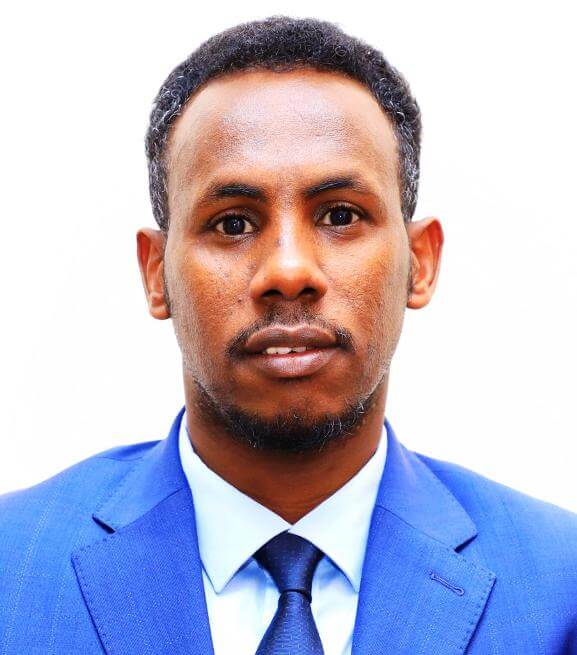
Director Risaala Media Corporation Mohamed Abdiwahab
Radio Risaala broadcast online 24 hours a day, seven days a week. Radio Risaala brings you the friendly voices of the community. As a community station, We also have religious programs, sport, local news and interviews etc.
Mogadishu, Somalia, 16 April 2026: The Somali Media Association (SOMA), with support from International Media Support (IMS), successfully concluded a series of workshops on 15 April aimed at strengthening collaboration between the police and the media in Mogadishu.
A total of 105 participants took part in the initiative, including district police station commanders, police investigators, media house managers, journalists, and representatives from civil society. The programme consisted of three separate two-day workshops designed to enhance mutual understanding, trust, and cooperation between police and media professionals.
Throughout the sessions, participants engaged in open dialogue, sharing experiences and perspectives. Hamda, a journalist from Risaala TV, recounted her experience of being detained for seven hours without due legal process while carrying out her professional duties, highlighting the challenges journalists face in the line of duty.
In response, Jamila, a police commander at Gubta Police Station, issued an apology on behalf of the Somali Police Force, acknowledging that the incident constituted an act of mistreatment. She underscored the importance of adhering to legal procedures and respecting journalists’ rights, particularly when they are performing their professional responsibilities.
The workshops also addressed a case of misinformation involving Ahmed Ali Yalahow, the police station commander of Kaxda District. False reports had alleged misconduct in a case involving a minor. During the workshop, a journalist who had shared the inaccurate information publicly apologized, and Ahmed Ali Yalahow accepted the apology. This exchange highlighted the critical importance of responsible journalism, fact-checking, and accuracy in reporting.
Speaking during the closing ceremony, Abdullahi Mohamed, Wadajir District Police Commander, on behalf of participating commanders, stated:
“This workshop has strengthened our understanding of the role of the media. Moving forward, we are committed to improving cooperation, respecting journalists’ rights, and ensuring that the law guides our actions.”
Burhan Dini, Director of Kulmiye Radio, speaking on behalf of media professionals, noted:
“The workshop has improved our understanding of police procedures and reinforced the importance of verifying information before publication. It has also strengthened trust between journalists and law enforcement, particularly the need for cooperation and adherence to lawful police instructions during emergencies.”
Mohamed Abduwahab, Secretary-General of SOMA, highlighted the significance of the initiative, noting that initial skepticism among participants had been overcome:
“This achievement demonstrates that progress is possible when there is willingness and commitment from all sides.”
He also expressed appreciation for the support and leadership of Mahdi Omar, Commander of the Benadir Regional Police Division, as well as the continued support of IMS.
Sheikh Bashir Ahmed, Chairperson of the Somali Council of Ulama, emphasized that national unity depends on strong collaboration between the police and the media, calling on both sides to uphold the law and their respective responsibilities.
Colonel Mahdi Omar reaffirmed that the primary responsibility of the police is to ensure public safety and expressed hope that the workshops would mark a new chapter in police–media relations, fostering mutual understanding and cooperation.
In his closing remarks, General Osman Abdullahi (Kanif), Deputy Commissioner of the Somali Police Force, commended SOMA and IMS for organizing the workshops and encouraged police commanders to apply the knowledge gained. He reiterated the Somali Police Force’s commitment to respecting press freedom and ensuring accountability.
Abukar Albadri, Head of Training, reflected on how the situation evolved from the beginning of the workshops, stating: “At the start, the two sides were seated separately. But by the end, we had reached a point where police and media were sitting together, engaging openly, and even leaving together in the same vehicles.”
One police commander also remarked, “This is the first time journalists have ridden with me in my vehicle,” Albadri added.
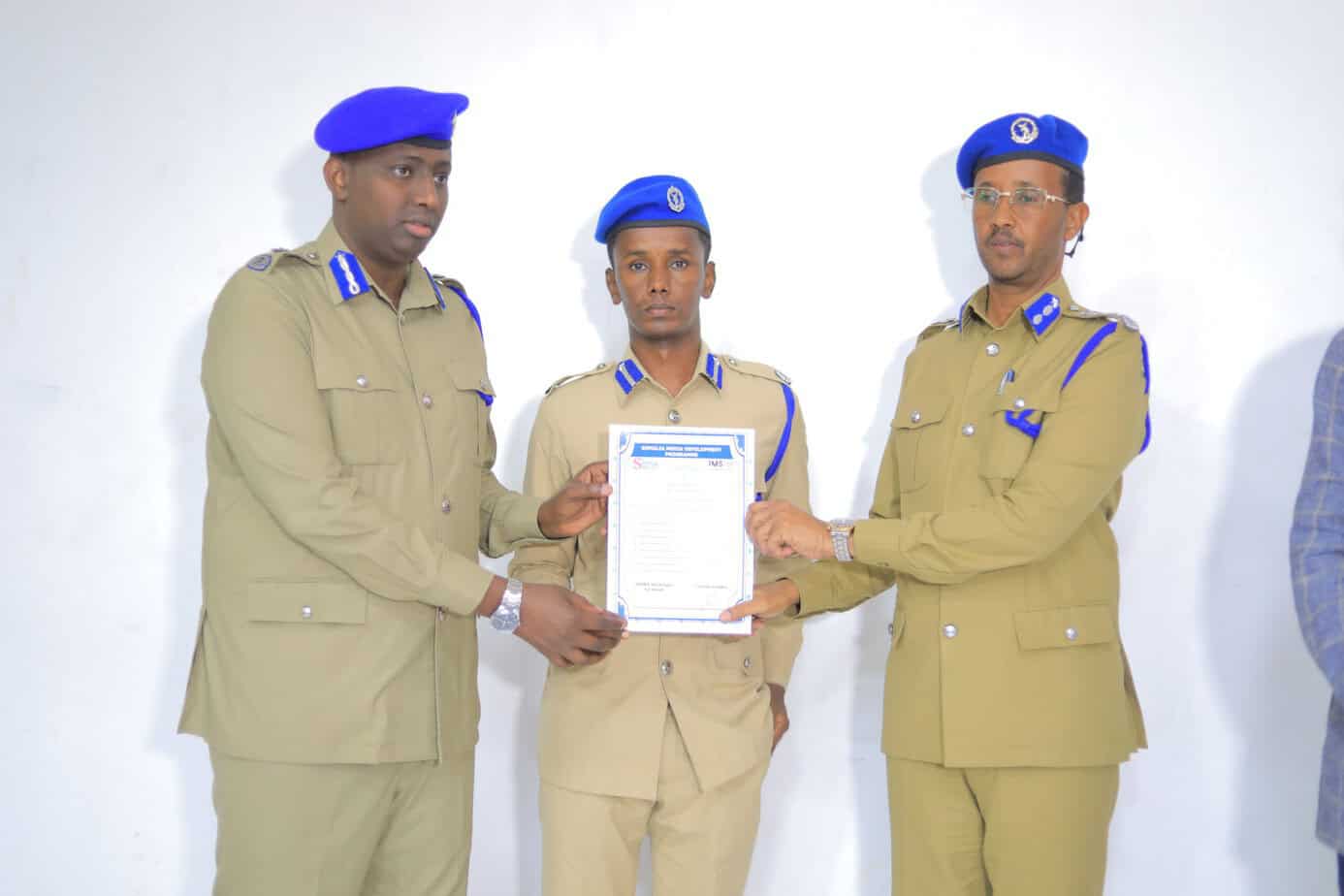
The closing ceremony included the presentation of awards recognizing key contributions to strengthening police–media relations. Ahmed Ali, a district police commander, was honored for his commitment to press freedom during critical moments.
Major Abdifitah Adan, spokesperson of the Somali Police Force, received a Certificate of Achievement for his dedication and support in implementing the workshops. Col. Mahdi Omar was also recognized for his leadership and commitment to the success of the initiative.
The programme comprised three workshops held on 1–2 April, 7–8 April, and 13–14 April, followed by a closing ceremony on 15 April. The series successfully brought together police and media professionals to foster dialogue, build trust, and strengthen collaboration.
Participants expressed a shared commitment to applying the knowledge gained, promoting responsible journalism, respecting press freedom, and enhancing cooperation between the police and the media. SOMA and IMS reaffirm their dedication to supporting continued engagement and capacity-building efforts to sustain these outcomes.
This website uses cookies to process personal data. You may accept or manage your choices by clicking below, including your right to object where legitimate interest is used, or at any time on the privacy policy page. If you continue to use this site we will assume that you are happy with it.
You can revoke your consent any time using the Revoke consent button.